🪩 Data Exploration
The dataset is the core of QUANTUM AQUA . In this section you can understand how the system:
- 🧮 Examine the dataset used to train the model.
- 📊 View descriptive statistics.
- 🖥️ Generate quick visualizations.
- 📈 Explore variable distributions and relationships.
🛰️ Satellite Optical and SAR:
NDVI: indicates vegetation health → vegetation stress often signals groundwater decline.
NDWI / NDMI: measure surface and vegetation moisture → correlated with shallow groundwater availability.
Spectral bands (blue, NIR, SWIR): detect soil dryness, crop conditions, water bodies, and surface reflectance tied to infiltration.
Soil indices (BSI, SAVI): indicate exposed soil, erosion, and moisture retention capacity.
VV & VH: respond strongly to soil moisture and vegetation structure.
VV/VH ratios: differentiate vegetation, waterlogged soils, and bare dry areas.
Dry–Wet contrast: reveals seasonal moisture patterns.
Coherence: identifies stable vs. changing surfaces — important for detecting land shifts due to groundwater extraction.
SAR is crucial because it detects moisture variability and structural changes, even under cloud cover.
🏔️ Topographic and Geological:
Topography explains natural recharge pathways.
Elevation: influences climate, recharge zones, and hydraulic gradients.
Slope: steep slopes → runoff; gentle slopes → infiltration.
Aspect: controls solar radiation and evaporation.
Curvature: concave areas accumulate water; convex areas shed it.
TWI (Topographic Wetness Index): estimates potential groundwater recharge zones.
Distance to rivers/valleys: proximity to drainage networks often correlates with groundwater storage.
🌦️ Climate and Hydrological:
Climate determines long-term groundwater sustainability. Hydrology explains surface–subsurface connectivity.
Rainfall: primary source of natural recharge.
Evapotranspiration (ET): water lost to the atmosphere.
Aridity Index: ratio of precipitation to evaporative demand → drought severity.
Drainage density: low density → high infiltration; high density → high runoff.
River order: indicates stability and groundwater–surface water exchange.
Upstream area: defines catchment dynamics and recharge inputs.
🌍 GRACE and Georeferenced real wells :
GRACE provides the deepest signal of subsurface conditions. Wells are the gold standard for verifying subsurface predictions.
TWS (Total Water Storage): total change in water mass.
Anomalies: detect droughts and extraction impacts.
Trends: reveal long-term aquifer decline or recovery.
Real Wells validate predictions against measured groundwater levels
Real Wells improve accuracy through calibration
Real Wells anchor the model’s outputs to real-world observations
Real Wells enable continuous refinement of the predictive engine
🧮 The training dataset integrates a comprehensive set of variables, including:
– 🛰️ Satellite Optical: Optical satellites reveal what happens on the land surface, which directly influences what occurs below the surface.
–📡 Satellite SAR: SAR penetrates clouds, works day/night, and captures information about surface roughness, structure, and moisture.
–🏔️ Topographic: Topography controls where water flows, accumulates, or infiltrates.
–🪨 Geological: Geology defines the subsurface architecture where groundwater is stored and transmitted.
–🌦️ Climate: Climate governs recharge, evaporation, and water balance.
–🌍 GRACE: GRACE measures mass changes below the surface — the only satellite system that can directly sense groundwater depletion at large scales.
–💧 Hydrological: These capture how surface water interacts with subsurface systems.
- 📍Georeferenced real well locations Real wells are essential for ground-truthing the model.
📊 Descriptive statistics:
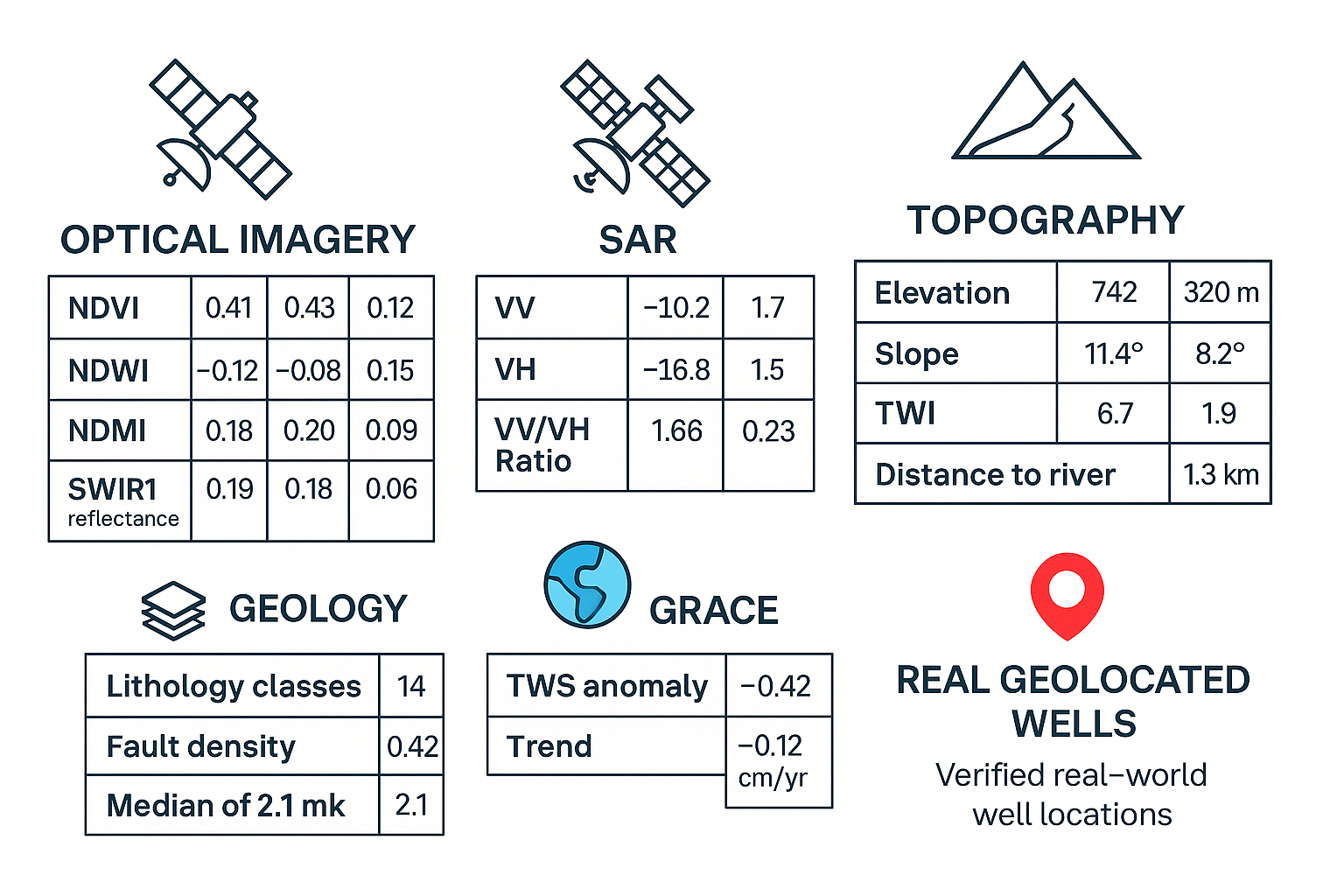
This graphic summarizes the key variables used to analyze and predict groundwater conditions, including satellite-derived optical and SAR indicators, topographic and geological characteristics, GRACE water storage signals, and real geolocated wells used for calibration and validation.
🖥️ Quick Visualizations:
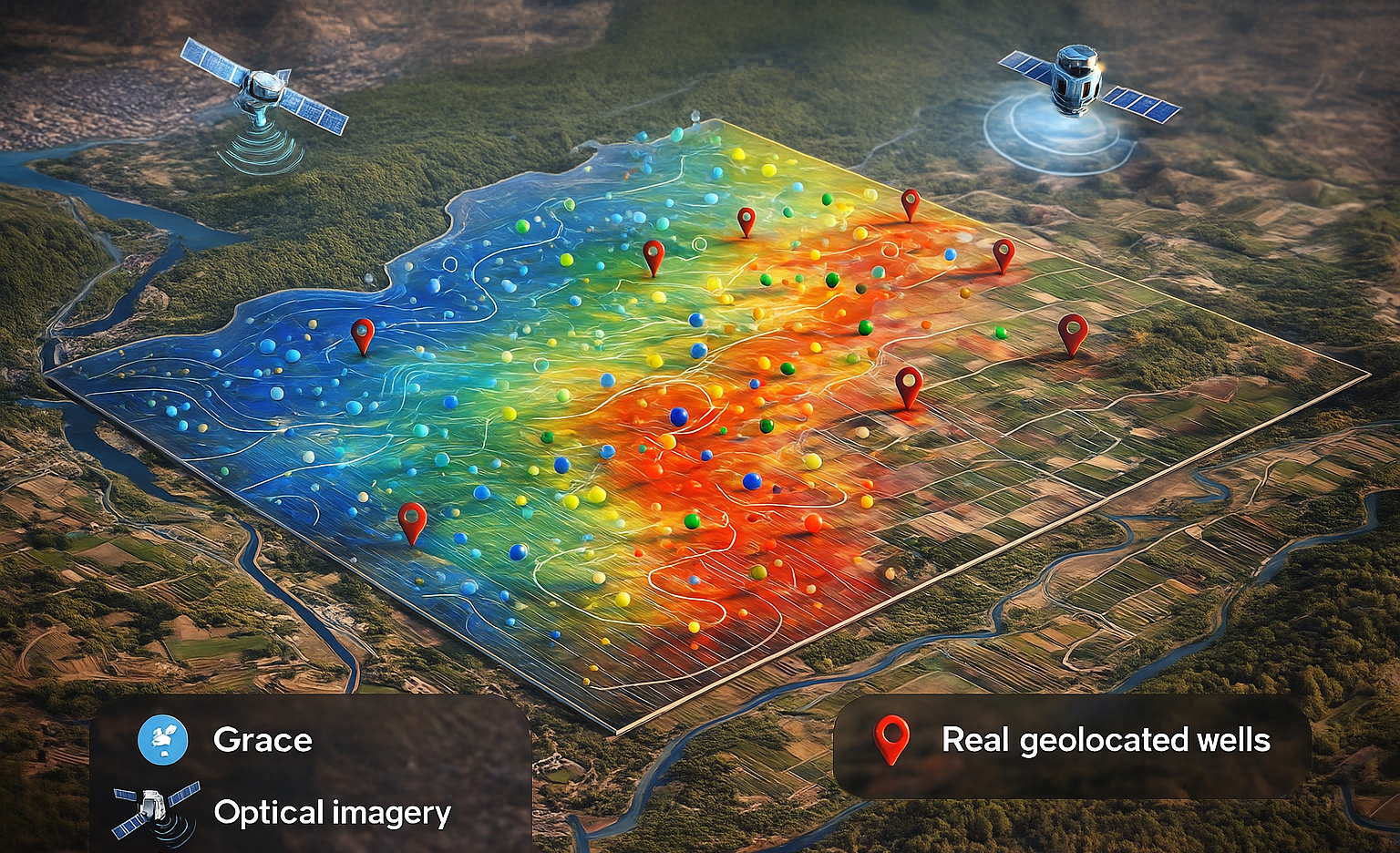
This visualization combines satellite data (GRACE gravity signals and optical imagery), hydrological variables, and real geolocated wells to generate a predictive groundwater map. The colored surface represents the model’s estimated groundwater conditions, the contour lines highlight spatial gradients, the colored dots indicate pixel-level predictions, and the red markers show actual well locations used for calibration and validation.

📈 Variable distributions and relationships:
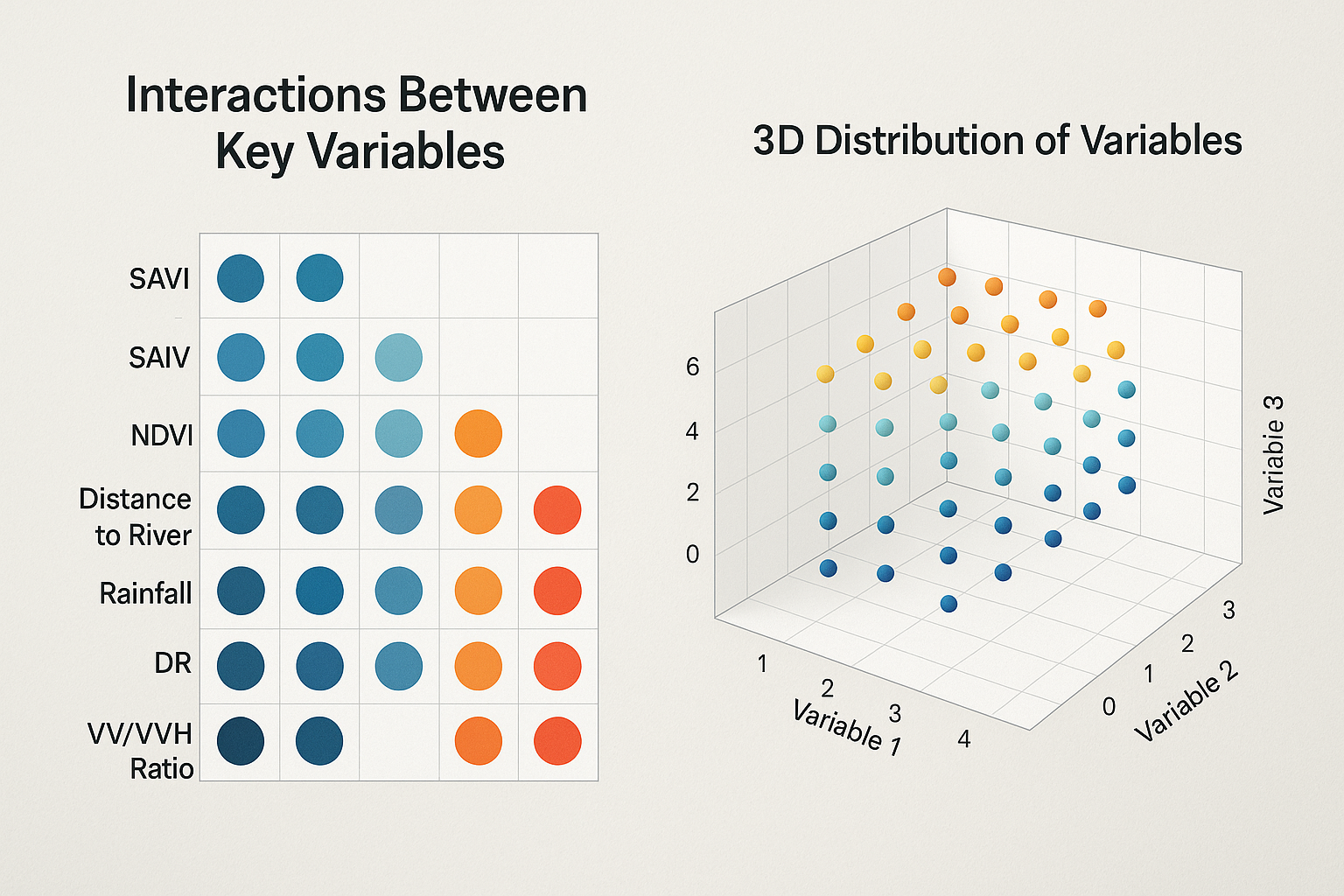
This figure illustrates how key variables interact within the groundwater system: the network graph shows relationships among satellite, climatic, geological, and hydrological indicators, while the 3D scatter plot displays their multidimensional distribution across the study region.